Sunday, March 17, 2013

Humble, humble

Here we are again. Sunday, the blinds closed, and I spend the morning paging through cookbooks on the floor in front of our gas fireplace, inching myself as close as I can get without crawling inside it. The temperature has tanked to 13 degrees again. This just ain't right.

Speaking of tanked, I went for a nine mile run on Saturday, which I then countered with, I'm not kidding, chips and queso dip, deep fried walleye fingers, chicken wings, a couple beers, chicken nachos, deep fried pickles, a couple more beers, cheese curds and sweet potato tots.

I wasn't even celebrating St. Patty's day; that's the worst part. I was wearing blue and going to non-Irish pubs. This was just another average night that got the best of me. When will I learn?

Today, I am secretly excited that there isn't enough snow for another cross-country ski attempt, because God knows I should be out there getting some exercise. At one point last night, guilty with mouths full of chips and sour cream, hands greasy with deep-fried batter, we all agreed we would need to have boiled cabbage and water for dinner on Sunday to counteract some of the damage we were in the middle of inflicting upon ourselves. There would have to be another long run before the weekend was over. The diet starts on Sunday.

We sure say some crazy things when we've been drinking!

Instead, today has been a day of staying inside, of standing in front of the hot stove stirring together a batch of oatmeal chocolate chip cookies, and, for dinner, a creamy pot of cauliflower paprika to warm us to the bones. And maybe soak up a little of that grease, if I'm lucky.


This cauliflower paprika recipe caught my eye when I was paging through a copy of The Moosewood Restaurant Cooks at Home at Half Price Books a few years ago. This recipe alone won me over - cauliflower, mushrooms, sour cream - I didn't stand a chance. There's something about these humble eastern European-style dishes that really calls to me; it's one of my favorite types of cuisine. I'm also drawn to recipes with paprika; I love the warmth and sharpness it brings to a dish, especially when it's rounded out with spoonfuls of sour cream like it is here. I must have been a peasant in a past life.

I purchased the cookbook that day, and this cauliflower paprika was the first recipe I made. I've been making it ever since. Served on a bed of egg noodles, this is the type of comfort food that fills your belly and sticks to your ribs, but somehow doesn't weigh you down. It helps that it's vegetarian; and, truthfully, I find it more flavorful than any chicken paprika I've ever attempted. I have tried adding cubed chicken to the mix for a complete meal, but I found myself picking around the chicken - I swear, vegetables are so much more flavorful than chicken. Since then, I have typically served this with a piece of simple roasted chicken on the side.

And maybe a nice dark beer and a warm fire, for cold nights like this.


Cauliflower Paprika
Adapted from The Moosewood Restaurant Cooks at Home

Note: Make sure to use good paprika for this recipe. Sometimes, if I'm feeling sassy, I'll substitute a teaspoon of the sweet paprika with a teaspoon of sharp paprika, which gives the sauce a nice kick. I serve this on a bed of egg noodles, and often with a simple roasted chicken thighs on the side.

10 ounces white button mushrooms, sliced
2 Tbsp olive oil
1 medium onion, chopped
1 red pepper, chopped
3 Tbsp sweet paprika
1/2 cup dry sherry
1 medium-sized head of cauliflower, cut into small florets
1 cup sour cream
salt and pepper
cooked egg noodles, for serving

In a large skillet, heat the olive oil over medium high heat. Add the mushrooms and a pinch of salt to help draw out the juices. Cook, stirring occasionally, until the mushrooms have browned and most of the liquid they released has evaporated, 7-8 minutes.

Add the onion and red pepper to the skillet and continue to cook, stirring, for 2-3 minutes, until the onions and peppers soften. Add the paprika, and stir to coat the vegetables. Add the sherry, cook 1-2 minutes (most of the liquid will evaporate). Add 1/2 cup of water, then the cauliflower; stir to combine everything, then cover and reduce heat to medium. Cook for 8-10 minutes, lifting the lid to stir occasionally, until the cauliflower has softened.

Remove the pan from the heat, and stir in the sour cream. Season well with salt and pepper. Serve over egg noodles, and maybe a piece of roasted chicken on the side.

Monday, March 11, 2013

Sunday supper; or, I'm going to enjoy myself, dammit

When I was growing up, my mom cooked big old fashioned Sunday suppers. The emphasis here is on big. She grew up in a family of nine, and although our family was only four, she cooked as though we were twice as many.

When my brother and I were called in from the backyard or down the block on Sunday evenings, we would tuck into the dining table set around a beef roast that had spun on the rotisserie, or a whole roasted chicken, or big racks of barbecue ribs, or a glazed ham. There would also be a salad, potatoes, some crusty bread, and, lest we go hungry, at least two kinds of vegetables: green beans, corn, sour-cream cucumber salad, roasted asparagus; the list is long. Sometimes the set-up would be a whole Thanksgiving dinner: turkey, stuffing and all the fixings, in June. Forget not the pie, crisp, cake or crumble setting on the counter for after.

Every Sunday, enough food to feed Coxey's army, as my mom would say.


Adam and I have our own version of Sunday suppers now. While we don't always cook bigger on Sundays, we do tend to make something more special that night; most often fish, usually a variety of vegetables, and always a glass of wine. When the clock is ticking ahead and we're slumping toward Monday, it's the best way I've found to keep the anxiety at bay; a small glimmer in what can be an otherwise dark tunnel to the start of a new week.

I like those evenings best when the apartment is quiet and the counter tops clear; I try to clean up as I work through the recipe so there's not much to do after dinner. Adam will ask how he can help, then without pause, fills my wine glass. We sit down to a simple meal, maybe a pan-fried salmon fillet with dill-flecked cucumber salad, a tea light lit in the center of the table and some clothes tumbling in the dryer down the hall. Adam at my side. We cheers to the week ahead.

And we cheers to the night, too, because it's still the weekend, and I'm going to enjoy myself, dammit.


This recipe combines one of my mom's classic sides with one of our regular Sunday night choices: Salmon with Sour Cream Cucumber Salad. The salad has long been one of my favorites - a mellow blend of paper-thin cucumbers, sour cream, red onions and tangy dill. Mildly sweet with an edge of vinegar; of all the roasts and fillets my mom set out on the table, this cucumber salad was always the dish I went to for seconds.

When I made this dish on Sunday, it was my first attempt at pan frying salmon. I typically just pop the salmon into the oven to bake while I prepare the rest of dinner, and I've actually gotten a little tired of salmon because of this - it has started tasting like a chalky pink slab on my plate with little flavor or texture. Inspired by a salmon fillet I had at a British-style pub recently that I couldn't stop gushing over, I wanted to create a crisp, salty edge and moist interior, and figured pan frying was my best bet. I followed the methodology in this great article from Serious Eats. I was worried about the skin fusing to my one and only (beautiful) All-Clad saute pan, and forever scaling any future pan-frying attempts - but this method worked beautifully. The salmon slid out of the pan with just the crisp and moist texture I was hoping for.

Here's to another week. Onward we go!

Pan-Fried Salmon with Sour Cream Cucumber Salad

Note: Tweak this salad with additional sugar, vinegar, dill or sour cream to suit your taste. My mom makes her's quite a bit sweeter, using more sugar and less vinegar than called for below. Mine has been getting more vinegary as time goes on; hopefully that isn't an indication of personality.

1 large cucumber
1 tsp kosher salt
1/2 of a small red onion, thinly sliced
1 1/2 Tbsp white vinegar
1 tsp sugar
1/3 cup sour cream
1 Tbsp dill, or more to taste
1 Tbsp canola or vegetable oil
1 salmon fillet with skin on one side (mine was Steelhead, about 2/3 lb)

For the cucumber salad:
Peel the cucumber and slice into very thin slices. If the seeds inside are big, you may want slice the cucumber lengthwise and scoop out the seeds and soft pulpy part with a spoon; discard. (You can see I skipped that step in the photos above because the seeds were fairly small.) Place the thin cucumber slices into a colander or fine mesh sieve set over a bowl. Sprinkle the 1 tsp salt over the cucs, and toss with your hands to distribute the salt evenly. This will seem like an insane amount of salt, but you'll squeeze most of it out later. The salt is going to draw out the extra water in the cucs so you have a more flavorful, less watery salad. Set the cucumbers aside to sweat out the liquid for at least an hour, up to a few hours.

After the cucumber slices have drained most of their extra water, place them in a mess of paper towels and squeeze out as much of the remaining extra water as you can. Dump the cucumbers into a bowl and add the red onion slices. Pour over the vinegar and sugar, and toss to coat. Stir in the sour cream and dill, and finish with a grinding of pepper. If it looks thin, add another spoonful of sour cream - you want a slightly thickened but saucy consistency. Taste here, and adjust the seasoning as you like; add additional sugar, vinegar, salt or dill to suit your fancy. Refrigerate until ready to serve; flavors will continue to meld as it sits.

For the salmon:
Dry the salmon thoroughly on both sides with paper towels; season well with salt and pepper. Set a heavy-bottomed skillet over medium high heat; add canola oil and heat until it's shimmering and very hot. Place the salmon in, skin side down first.

After you set the salmon in the pan, reduce heat to medium-low. You'll cook it most of the way on the skin side - the skin protects the rest of the fillet from cooking too quickly and drying out. Cook for about 6-10 minutes, until salmon is almost done (my fillet was about an inch and a half thick, and took 8 minutes or so on the first side). If your pan was hot enough when you started, the skin will have released from the pan when it's time to flip. Use a spatula to turn the fish over and cook on the other side, another minute to crisp it up and finish cooking.

Salmon should cook to 120 to 140 degrees; of course, 120 degrees will render more of a rare to medium-rare fillet, and closer to 140 for a medium-well, but still light and flaky, bite.

To serve: I like this meal with a bed of jasmine rice, the salmon fillet set over, and cucumber sauce scooped on top.

Tuesday, March 5, 2013

No shame in that!

Let's face it - the eight inches of new snow covering everything this morning was a bunch of crap a minor setback.

After a weekend of sun, sun, sun!
After watching the snow drip away steadily into long, flowing puddles on pavement
After taking our jackets off on a warm, hilly hike on Saturday
And then, Sunday, seeing the smallest patch of grass peek through the most-worn part of the cross country ski track (oh, believe me, that whole skiing thing is a story for another time)

And then - eight inches of new snow to cover it all up again. With banks of snow now twice my height in our parking lot.

What can you do?

As I see it, you really have two choices here. You can hunker down yet again with your heaviest blanket, an entire row of Double Stuf Oreos and a movie about teenage magicians, and wait for better times. Or, you can turn off the gas fireplace and shake your fist at the sky - because when mother nature hands you an endless winter, you make beets and potatoes!

(Or, maybe like me, you do both. There's no shame in that!)

Today, in honor of the endless winter with nothing but root vegetables as far as the eye can see, I'm giving you: beets with horseradish, and dill potatoes. These really are two of my favorites, for winter or anytime. Both of these recipes jazz up the vegetables more than simply roasting or boiling them, but each requires no more than three ingredients and three steps from start to finish. 

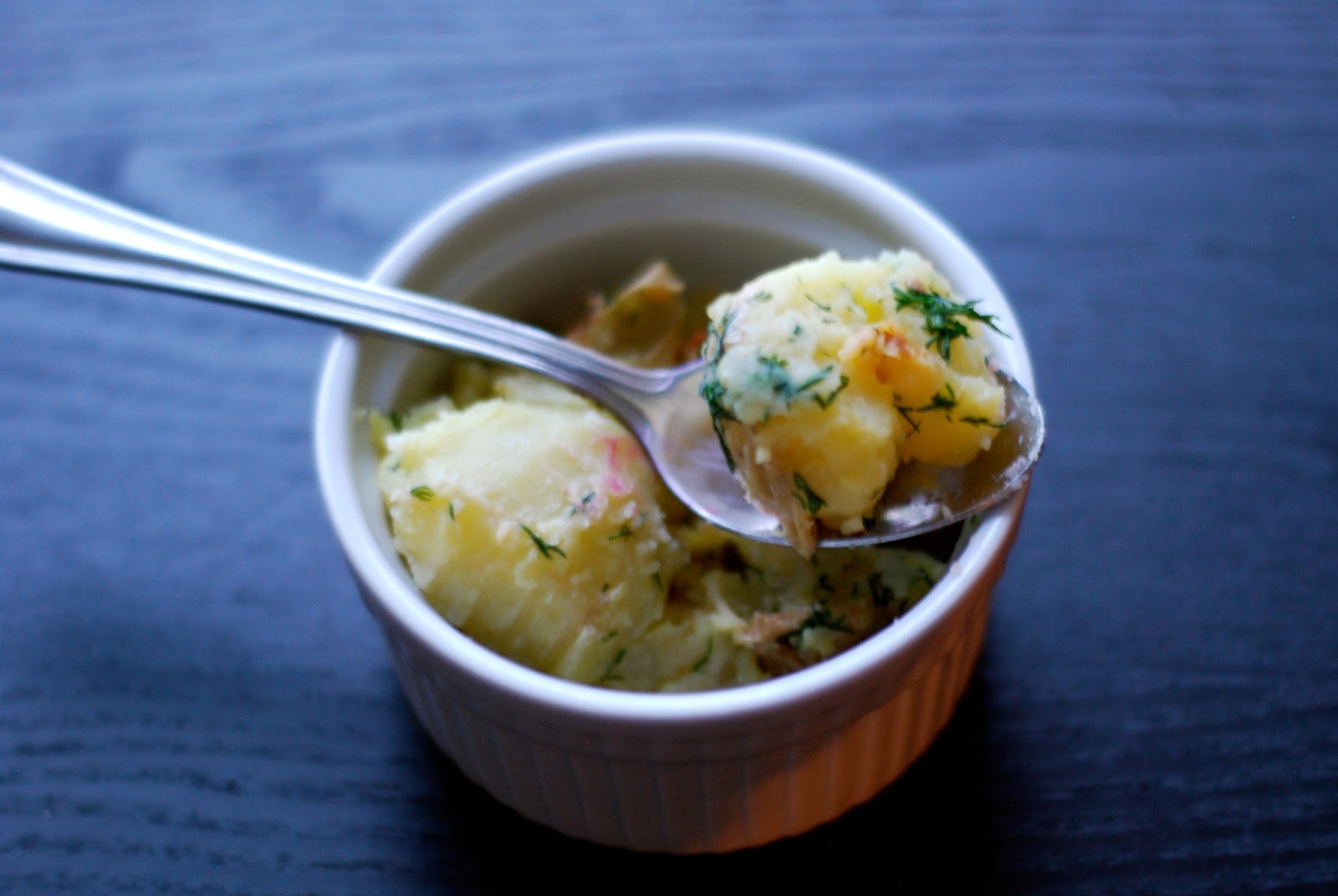
For the potatoes: I made these all the time last summer, after I would end up with a plastic grocery bag of dill from the farmer's market that I would never be able to get through. I made them again last week, and man - they are incredible. Light and buttery, intensely creamy, with the lightest tang of dill brightening them up. You cook them until they just start breaking down and just start to brown in spots; when you serve them, they are sort of a cross between the texture of roasted and mashed potatoes. I seriously ate at least a potato's worth out of the pot while the rest of dinner was cooking; I couldn't keep my spoon out of it. They are that good.

And, here's my case for the humble beet. Perhaps it's weird to have such an affinity for both beets and horseradish, but I can't get enough of either. The beets create a sweet, earthy base, which is cut by the sharp, creamy horseradish sauce; it's the perfect combination. And, the bright red looks so pretty on the dinner table. I know beets aren't for everyone, but if you're going to give them a try (especially if you like horseradish), this is a fantastic way to start. I used four beets the last time I made this, and Adam and I left the bowl clean.

To winter!


Beets with Horseradish
Adapted from Sundays at Moosewood Restaurant

3-4 beets (about 3/4 lb)
3 Tbsp sour cream
1 1/2 - 2 Tbsp prepared horseradish root
1/4 tsp salt

To roast the beets:
Preheat oven to 400 degrees. Create a tinfoil pouch for the beets, and seal it tightly. Place the foil pouch on a baking sheet. Bake for about 1 hour - beets are done when you can pierce them easily with a fork. When they are done, carefully open the foil packet and allow beets to rest until cool enough to handle. Peel the beets while they are still warm (the skins seem to slip off more easily when the beets are still warm).

For the salad:
Slice the beets into julienne strips about 1/2 inch wide. Place the chopped beets in a bowl, and add the sour cream and 1 1/2 tbsp horseradish; stir gently to combine. Season with salt. Taste for heat and seasoning - if you would like them hotter, continue to add horseradish until it's to your liking (I like mine hot-hot, and typically use 2 Tbsp or more). Chill until ready to serve.


Dill Potatoes
Adapted from Ina Garten

1 lb Yukon gold potatoes
1 1/2 tbsp butter
1/4 tsp kosher salt
2-3 tsp fresh dill, chopped

Chop the potatoes into quarters, so they are about the size of a golfball cut in half (I couldn't think of anything else that size?). Put a medium sized pot over medium heat; toss in the butter and potatoes, and season with the 1/4 tsp salt. Cover. As the butter melts, shake the pot to evenly coat the potatoes. Continue to cook for about 15 minutes - every few minutes, hold onto the lid and shake the pot to toss the potatoes around (do not remove lid during cooking).

After about 15 minutes, when you give the pot a shake, notice if the potatoes start to look a little banged up and soft - if so, they are done. You want the skins to start loosening and the potatoes to just start breaking down; they will probably start browning a little on the bottom, too. If they're not done, cook a few more minutes until they are very soft.

Remove from heat; add the dill and toss to coat. Taste for seasoning, and add more salt if needed.